Thursday, August 26, 2010

The Big Small Question

Has your company answered the big small question? If not, it could be a continuing source of distracting consternation.

What is the big small question? First, a bit of background, well-articulated by Ridgely Evers in a recent issue of American Express’ OPEN BOOK. Evers headed up the creation of Quickbooks at Intuit, has served as CEO of a number of Bay-area companies, is managing partner of a venture capital fund and is a board member of SCORE. In other words, he’s been around. He says:

People think there’s some kind of continuum between the smallest and biggest business – an unbroken line between me and the mouse on my desk and Microsoft – and that there’s some magical moment where you transform from being a small to a midsize to a large business. In fact, research shows that to be very far from the truth. Each form of business is a totally separate beast, and there are vastly different skill sets in running each one.

The real difference between a small business and an enterprise is the owner’s attitude toward growth. A Silicon Valley start-up is completely focused on getting big, and naturally risks failure to get there. A true small business, on the other hand, is focused on becoming profitable, feeding a family, and staying in business. That’s a fundamental psychographic and cultural difference.

I’ll say it is. And it can be a source of friction—often misunderstood, perhaps even unrecognized—at growing companies. Unless the entire leadership team is aligned and on board with respect to growth and profitability objectives (and the resulting risk ramifications), members of it are likely to make counterproductive decisions.

Which leads to the big-small question: Is your organization a big small company, or a small big company? How you answer that will impact just about every strategic decision you make. There is no right answer; the only wrong answer is not having an answer.

I’ve said it before but it bears repeating: the number one issue that keeps struggling companies from effectively recovering is not a loss of focus, a loss of nerve, or marketing inconsistency (although all are contributing factors); it’s a lack of strategic alignment among the management team. If your company hasn’t answered the big small question, make it a top priority. It will not only affect how you answer other things, it may change the questions altogether.

Monday, August 16, 2010

What Price Potatoes?

How much would you pay for a five-pound bag of potatoes?

If you saw two similar bags of potatoes, one priced at $3.00 and one at $3.25, I suspect you’d choose the $3.00 bag. Even though the price difference is small, it offers a better value.

But what if one bag was priced at $3.00 and one at 59 cents? Would you still choose the cheaper one? Perhaps not, because you’d figure there was a reason why it was so inexpensive—and not a good one. Your value equation would be different in this case than when the potatoes were close in price.

Now take it in the other direction. One bag of potatoes is $3.00, and another is priced at $8.50. You may indeed still choose the $3.00 bag, but I’ll bet you’d stop and consider why the other was priced so high. Maybe there’s something really special about those potatoes that provides a different sort of value. Some people, I dare say, would purchase them just to find out.

One of my most popular BusinessWeek.com columns is “Five Words to Never Use in an Ad.” One of those words is value, and for good reason. What constitutes a value is not only different for everyone, it can differ by purchase occasion. And as the potato example demonstrates, it can even differ based on the dynamics of any set of circumstances.

I was fascinated to read an interview with David Ovens, Taco Bell’s CMO, in which he described the brand’s value proposition in three ways: price value (79-, 89- and 99-cent menu items), abundant value (larger products like a triple steak burrito) and quality value (new ideas like the “Fresco” menu). The chain’s pricing strategy further reinforces the point, and as a fairly regular customer of Taco Bell (thanks to my teenage son) I find even my own value equation changing depending on the circumstances.

Like a complicated mathematical formula, value is based on a number of variables. Change any one of those variables and you change the result. That’s why it’s vital to put the “who” before the “how much” in your pricing strategy. Value is as much about your customers as it is what they’re buying.

Friday, August 6, 2010

R.I.P. Travel Agents. Or Not.

“The reports of my death are greatly exaggerated.” I was reminded of that Mark Twain quip by a statistic I just stumbled across; according to Forrester Research, 27 percent of travelers used a travel agent this year, up from 23 percent in 2008.

Huh? I thought the Internet sounded the death knell for travel agents? At least that’s what everybody predicted. I mean, who would need anyone to help put together a trip when now it’s all right there on the Web?

More than one out of every four travelers, that’s who. Myself included.

Oh, not for everyday business trips on well-known airlines to familiar cities. Those excursions are indeed simpler for me to book myself. But the next time I’m headed to an unfamiliar place where choosing the wrong hotel (or the wrong airline, or restaurant, or transportation, or part of town) can mean the difference between a memorable experience and a disaster, I’m likely to seek professional help. Sure, the Web is a terrific way to filter information, but there’s a whole lot more to filter these days, and I just don’t have the time or inclination to do it.

Sure, the travel agency industry has evolved; it has had to. But there isn’t any sector of the economy that hasn’t—or doesn’t.  In fact, travel agents may have even had an advantage in that the threat to their existence was so tangible that it created an undeniable sense of urgency.

Change in other industries tends to be more subtle. In the ad agency world, for example, there are some changes that everybody sees coming. But there are also those that are happening a bit more under the radar. I think my firm has a good handle on them (and we’re leading the way on some), but I’m under no illusions that there could still be something we’re not seeing.

No company can survive if it becomes irrelevant. My hat is off to those nimble travel agents that paid attention, kept their eye on the ball and found a new way to compete. If those of us in other industries follow their example, it will keep us from missing the boat.

Friday, July 23, 2010

The Power of a Poor Experience

In my latest  BusinessWeek.com column I focus on the need for and power of authenticity in branding. I began the column with the story of Citi, which has been about as inauthentic a brand as there could be over the past couple of years. New CEO Vikram Pandit is claiming to have turned things around, and I hope he has. We’ll see.

Unfortunately, it’s much easier to find examples of brands that are falling down on the authenticity job than those which consistently succeed. That’s why a recent experience I had with Southwest Airlines was so intriguing to me.

A few weeks ago a group of MWC staffers and I were at the Southwest ticket counter checking our bags, and we ran into a particularly nasty agent. She seemed angry at us for simply being there, and scolded us as she rushed us for no apparent reason. There were no long lines, we weren’t late for our flight—we simply offended her by showing up. Or maybe she was just having a bad day.

As we joked about it on the way through security, I noticed how I was interpreting the event differently than I would have if she had worked for, say, American or Delta. In that case it would have been easy to count the bad experience as one more example of how legacy airlines don’t give a rip about their customers. I know I’m overstating it a bit, but  I have come to expect poor treatment from those brands (hey, at least they’re consistent).

In this case, however, I not only gave Southwest a pass, I actually felt sorry for the brand. One of their own was behaving in a way that hurt it, and I didn’t want that to happen. Southwest has been so consistently authentic over the years that the space the brand occupies in my brain simply rejected this one example of rude behavior.

Southwest, like every brand, isn’t perfect. But it is authentic. And that authenticity has built up such equity over time that one bad experience did no damage—in fact, it may have in an odd way enhanced the brand by making me consider why I reacted the way I did. If it happens again soon I may start to reconsider, but for me this experience served as an exception that proved the rule. Kudos to Southwest.

Monday, July 19, 2010

Desperately Seeking Sincerity

My next BusinessWeek.com column takes on the topic of authenticity in branding. In it I describe how the Citi brand is suffering from (among other things) an authenticity crisis.

Companies that didn’t make the cut in the column include Nike, Southwest Airlines and Chipotle, among others, and I will be commenting on their brand authenticity (or lack thereof) in upcoming posts, some of which may surprise you.

I’d like to invite your suggestions on other brands that may be particularly authentic—or authenticity-challenged. Feel free to comment below or drop me an email at Steve.McKee@WhenGrowthStalls.com with your thoughts on which, and why. If I use your idea I’ll be happy to give you a plug. And look for my column this week.

Thursday, July 1, 2010

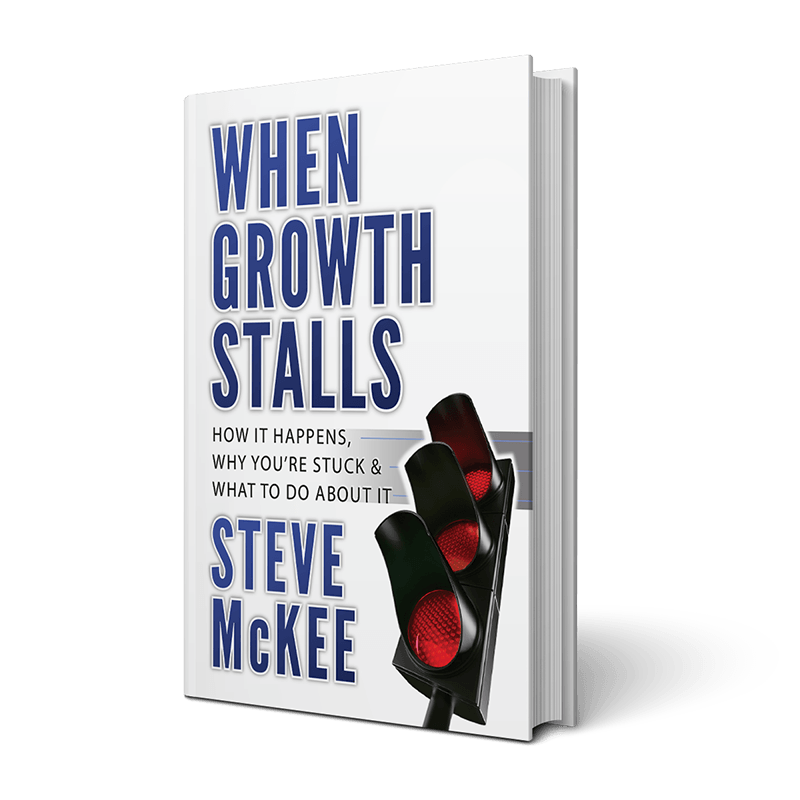
Highlights (Literally) of When Growth Stalls

One of the cool (or creepy, depending on your perspective) aspects of the Kindle e-reader is its “Popular Highlights” feature. It lets you see what other people who have read what you’re reading thought was interesting enough to underscore.

Below I’ve listed a handful of popular highlights of When Growth Stalls. I think they offer a window of insight into readers’ thinking as our economy continues to languish. And taken together they offer a nice (if incomplete) overview of the book:

I learned two valuable lessons: number one, insane market momentum can’t go on forever; and number two, even in the best-run companies, growth stalls.

————————————————————————————

To ride out a downturn, it’s important for every company to “store nuts.”

————————————————————————————

The most important thing to remember when hard times hit is to keep your wits about you. Protect your assets, play for the long term, and make sure your people know you have a plan.

————————————————————————————

Trying to get everybody to agree on everything is not leadership, it’s a form of passivity. And it is impossible to boot. What consensus does mean, in this context, is agreement among an organization’s senior leadership about the nature and purpose of the company and where it’s intended to go.

————————————————————————————

“Results are obtained only by concentration of resources, especially by concentration of the scarcest and most valuable resource, people with proven performance capacity.” (Peter Drucker quote)

————————————————————————————

Whether your target is a CEO in the boardroom determining the fate of a multibillion-dollar contract, or a parent in the supermarket deciding between two boxes of cereal, your task is to understand your audience, determine what they’re looking for, and align your product or service with their wants and needs.

————————————————————————————

As the “U.S. Army Leadership” manual knowingly states, “No plan survives initial contact with the enemy.”

If you haven’t picked up a copy of When Growth Stalls yet, I encourage you to do so. It’s available at most bookstores as well as on Amazon.com and Barnes & Noble online. As the highlights above (and recent reviews) indicate, its advice is as relevant as ever.

Friday, June 25, 2010

What’s a Fair Price?

That was the question asked and answered at a recent auction for this rare, 125-year-old stamp. It’s called the “Treskilling Yellow”, and its claim to fame is that it should have been green. It was recently sold to a secretive investor group at an unknown price, but the last time it publicly changed hands was in 1996 when it went for the equivalent of (hold on to your hat) $2.3 million. Those who should know say that despite the undisclosed price of its recent sale, this remains the world’s most expensive stamp.

There’s no question the price was high. But was it fair? At first glance, that’s more difficult to answer.

Let’s see. There was a willing buyer, which apparently is happier now in possession of the stamp than it was with two or three million bucks. And there was a willing seller, who (much more understandably) is happier having traded his or her yellow scrap for greenbacks. Both parties believe they are better off having made this transaction. Sounds fair to me.

It’s natural for people to think of  low prices as “fair” and high prices as “unfair.” But where, exactly, does one draw the line between “low” and “high”? The answer differs by category, by product, by geography, by economic conditions, and by a host of other factors that no individual person is fit to judge, other than for himself. A “fair” price is neither high nor low; it’s simply the price at which willing buyers and sellers meet.

Personally, I think the group that bought the stamp is crazy. Unless they can find someone crazier to pay even more for it and make out like bandits.

Now that would be unfair.

Thursday, June 17, 2010

Hope and Sanity at Starbucks

Last spring McDonald’s launched a $100 million salvo in support of its new McCafe line of coffee drinks. I (along with everybody else) was worried about how Starbucks would fend off such an attack, and I wrote about how I hoped the company would be careful in how it responded: “Starbucks isn’t just a coffeehouse, it’s a concept. It’s not something to be explained, it’s something to experience. It’s not an argument, it’s an aesthetic.”

I’m happy to report (as a grande-extra-hot-no-water-soy-chai lover) Starbucks is doing well. After retrenching, the company’s same store sales have begun to rise once again, less impacted than anticipated by McDonald’s attack (in part because of an unanticipated convenience factor—a Morgan Stanley analyst calculated that only 23 percent of Starbucks’ locations are within a quarter mile of McDonald’s).

Starbucks has now decided to increase its anemic marketing budget (historically less than 1 percent, a fraction of what fast food chains spend), which is a good sign. But what the company does with those dollars remains critical. I haven’t been a big fan of the argument-based newspaper ads Starbucks has been running.

When Starbucks really began to take off in the mid-1990s, it spent virtually nothing on marketing (a mere $600k in 1995). But the company sought and found the emotional connections surrounding its brand and built upon them everything it became. That’s when “The Third Place” was born, summed up well by an internal video manifesto: ”Coffee and tea. And hope. And a little bit of sanity.”

I implored back in May and I’ll implore again: Don’t say it, Starbucks, show it. Don’t make your advertising about you, make it an extension of you. Let the other guys do the boring, rational stuff, while you leverage the much more powerful emotional and aesthetic dimensions. That’s how your brand became beloved. Don’t now become like every other left-brain-driven retail advertiser.

Let’s hope “a little bit of sanity” prevails and Starbucks won’t be driven by the research deck as it invests its new marketing dollars.

Friday, June 11, 2010

Being Intuit

A few years back I had the opportunity to soak up the wisdom of Scott Cook, the founder of Intuit, as he reflected on the history of his company. Intuit is the maker of Quicken, QuickBooks and TurboTax accounting software applications.

Intuit recently announced its quarterly results—an incredible 13 percent increase in revenue and a 16 percent rise in operating income. This is a company that has enjoyed steady success for a long period of time, and Cook’s remarks reveal insights into why.

Cook revealed the backstory behind the launch of QuickBooks, Intuit’s small business software. Prior to QuickBooks, the company was focused exclusively on Quicken, its groundbreaking consumer product. Subscribing to a belief in a “relentless focus on the customer,” Cook said Intuit was slow and perhaps a bit reluctant to expand to another market. In fact, the idea for QuickBooks arouse when Intuit discovered that 50 percent of Quicken users were using it for business, a fact Cook says he basically ignored for two years.

When they did decide to get into the small business market, Cook and his team did it with nerve. “If you go to a new segment,” he said, “you have to be relentless about building from the ground up. You can’t just hack something together.” Shortly thereafter QuickBooks, “the first accounting software to do accounting without accounting,” was born. The target was companies with fewer than 20 employees who weren’t accountants and didn’t want to be accountants.

With a combination of diligence and urgency, Cook did his homework, drawing on his experience as a brand manager at Procter & Gamble. “It’s very common for people to say they do one thing and then actually do it a slightly different way,” he said, citing as an example the fact that people say they sort laundry more often than they actually do. He focused his team on developing a product with the right functionality, while recognizing the danger of feature creep that tends to plague new software (and delay its launch). “The reason we do version one of any product is so we can do a great version three,” Cook said.

Version one was good enough to win a commanding share of the market, despite a price point ($99) that was double that of competing products. The price was, Cook admitted, “built on a hunch,” but because QuickBooks was dramatically different its price was fairly inelastic.

Since that time Intuit has steadily added features and functionality (and margin) to the QuickBooks suite of products, which now start at $199.95. The company confidently promises that the software will pay for itself in 60 days.

Cook has since relinquished his CEO title (he’s now chairman of the company’s executive committee) but his influence is still apparent and there’s no reason to mess with success. “The difference between a groove and a rut,” Scott says, “is whether your stuck.” I’d say Intuit has been in a groove for some time now.

Monday, June 7, 2010

Predictable Success. Or Not.

I recently read a terrific new book by Les McKeown called Predictable Success. While the title makes McKeown’s book sound like the antithesis of When Growth Stalls, I was amazed by the parallels between his work and mine.

Of the many passages that caught my attention, this one in particular stood out: “Just like any other complex entity, the Predictable Success organization is far from perfect—it will make mistakes, hit roadblocks, and is just as exposed to the impact of external events beyond its control as any other organization. The difference is in how the Predictable Success organization responds to those difficulties.”

I couldn’t agree more with that statement, and two recent announcements in the business press prove the point.

The first is about the incredible second quarter results announced by Whole Foods, where same store sales rose 8.7 percent. That’s a far cry from the company I wrote about back in August that was distracted by its 2007 acquisition of rival Wild Oats and the drawn-out antitrust battle that resulted. In a Wall Street Journal article around that time, Whole Foods’ founder John Mackey was dismayed by how the company had lost its way, saying “We sell a bunch of junk.” It was then Mackey decided to refocus the brand back to its natural foods roots. Less than a year later, here we are talking about the “predictable success” that resulted.

The second is Ford’s recent announcement that it was shuttering for good its 71-year-old Mercury brand. Ford has done a tremendous job under CEO Alan Mulally of sharpening its focus as a company, but was unfortunately unable to resuscitate a brand that had become unfocused since its 1960′s heyday.

In his book McKeown quotes Jack Welch, who said, “The only way to change people’s minds is with consistency.” Whole Foods recognized the error of its inconsistent ways and quickly recovered, while Mercury languished too long in its own and has paid the ultimate price as a result.

Business is a contact sport, and there are many things that can derail a company for good when growth stalls. But as McKeown points out in his book, each of us can increase the odds of attaining “predictable success” if we’ll stay as alert to what’s happening within our organizations as we do to external events.

Thousands of years ago King Solomon said, “Know well the condition of your flocks.” It’s as good advice now as it was then.